A Practical Ceiling Fan Routine for a More Comfortable Home
Author: Anne Cowart | Editor: Omar Alonso
Review & Research: Jen Worst & Chris Miller

A ceiling fan left running in an empty bedroom is easy to overlook. So is a fan working at full speed while afternoon sun falls across the bed. Both are reasons to review how a room is used before buying more equipment. AirSurferHome's seasonal ceiling fan guide offers a starting point for checking direction and airflow. The next step is a household routine that connects those settings to occupancy, shading and an actual comfort need.
Start with the hours when nobody benefits

A ceiling fan moves air; it does not refrigerate the room. In ordinary warm-weather use, its useful effect is the breeze felt by a person. Leaving it running solely to cool an empty room adds operating time without providing that occupied-room benefit.
Walk through the home once during a normal day. Note which fans run after people leave, which lights stay on with them, and whether the controls allow the fan and light to be operated separately. Include rooms used in short bursts, such as a home office between calls or a bedroom after everyone gets up.
Choose a rule people can follow: switch off the fan when leaving an empty room after a cooling session. Keep controls accessible. A timer, if already supported, may help with a predictable routine, but adding a connected device is not a prerequisite. A winter circulation arrangement should be assessed separately rather than treated as the same cooling task.
Match the response to the source of discomfort

Air movement, solar shading and air conditioning perform different jobs. If direct sunlight reaches a reading chair every afternoon, first try the room's suitable existing shade before the sun reaches that position. Then check whether the fan is still needed at the same speed.
If the whole room remains too warm, turning the fan up does not resolve a cooling-system fault. Keep furniture clear of supply and return openings as directed by the equipment manufacturer, review the normal operating schedule, and seek qualified service when temperature control is not working properly.
Start with one room and one adjustment. Trying a shade, a new thermostat schedule and a different fan speed simultaneously makes it difficult to tell which change helped. The useful question is specific: does this seat feel comfortable with less unnecessary equipment operation?
Set the fan for the season and the occupied position
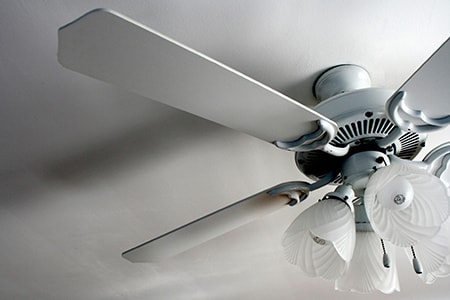
Check the model's instructions rather than relying only on a direction label. Many residential fans use downward airflow for warm-weather comfort and support a reverse setting for gentler cool-weather circulation. Blade design, mounting height and room layout affect what occupants actually feel.
For a warm-weather check, sit where the fan is normally needed and start at a low supported speed. Increase it only until the breeze is comfortable. A setting suitable for people moving around the room may be distracting at a desk or beside a bed.
Before using a physical reverse switch, turn the fan off and let the blades stop completely. Follow the manual for access and operation. In cooler weather, assess whether the supported reverse setting improves comfort without an unwanted draft; do not assume that changing direction guarantees a lower heating bill.
Put unnecessary run time into kilowatt-hours
A simple calculation makes the running-time decision concrete:
Electricity used in kWh = operating power in watts x hours of use / 1,000.
For an illustrative example, suppose a fan draws 40 watts at the selected setting and runs for four hours after everyone leaves. Those four hours use 0.16 kWh. Repeating that routine on 30 days would use 4.8 kWh. These are assumed inputs for a calculation, not measurements or specifications for the pictured fan or any AirSurferHome product.
Use the actual operating power for the relevant speed when it is available. A maximum nameplate rating is not necessarily the draw at a lower setting. Account for the light separately if it is not included in the power figure. For hardwired equipment, use documented information or qualified help rather than improvising an electrical measurement.
This calculation describes fan electricity only. It does not establish an air-conditioning saving, a household bill reduction or a carbon reduction. Those comparisons need additional information, including cooling-system operation, weather and the electricity supply.
Use a short, repeatable room check
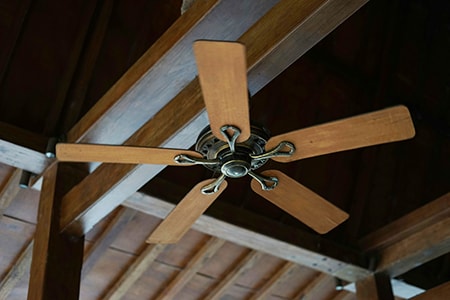
Write down the time, occupancy, shade position, fan setting and how the room feels. Compare broadly similar conditions, then keep the change that solves the original problem. The following checklist separates the action from the result being checked. Each number relates to the same number in each list.
What you notice:
- The fan runs after the room empties
- Direct afternoon sun reaches the occupied seat
- The breeze is stronger than needed
- The light stays on whenever the fan runs
- Temperature control remains inadequate
What to change first:
- Add switching it off to the leaving routine
- Use the suitable existing shade earlier
- Try a lower supported speed
- Check whether the existing controls operate them separately
- Review normal equipment operation and arrange appropriate service
What to check:
- Whether empty-room operating hours decrease
- Comfort at that seat during a comparable sunny period
- Whether the occupant remains comfortable
- Whether lighting can be limited to when it is needed
- Whether the underlying fault is identified and resolved
For example, a household might find that an office fan is left on through a long midday absence. Switching it off removes those running hours while leaving the occupied-room routine unchanged. Another household might need to address afternoon sunlight first. These are illustrative situations, not reported customer results.
Buy only for the need that remains
After the room check, describe the unresolved need before comparing products. It might be airflow at the desk, controls that are easier to reach, or replacement of equipment that cannot reasonably be repaired. That requirement is more useful than choosing an appliance simply because its description says "green."
Compare documented power and airflow information, suitable mounting conditions, available controls, maintenance instructions and replacement-part support. Compare like-for-like operating settings where possible; motor wattage alone does not tell you whether a fan will provide the required airflow in a particular room.
A practical home-energy routine starts with the equipment already installed: use shading where it helps, direct airflow toward occupied spaces, and remove running hours that serve no purpose. Revisit the routine when the season or room use changes. A new purchase becomes easier to justify when there is a clearly defined problem left for it to solve.
You'll Also Enjoy:
- Why is My Ceiling Fan Clicking? Fix Common Issues
- Should You Install a Ceiling Fan in the Kitchen?
- 7 Ceiling Fan Alternatives: Keep Cool Either Way!
- The Standard Ceiling Height Found in Most Residential Homes
- Can a Bathroom Fan Vent Into an Attic? No & Why
Author: Anne Cowart
 Anne is a full-time homemaker and ex-professional house cleaner, spending the past 17 years mastering the arts of cleaning and cooking. Now that her children are older and leaving the nest, she's sharing her expertise with others online who are entering this journey. Anne serves as an author in these two areas, where her experiences, tips, and techniques have proven an invaluable resource to our readership. Learn more on Anne's author page and all about Worst Room here.